

Before we get started, there are a few things I should be up front about:
I’m no expert; I’m just an amateur fitness and health enthusiast. That said, you’ll probably find me pretty opinionated for a guy without credentials.
This post isn’t intended to be professional advice (blah, blah, blah); it’s just a recap of my experience setting New Year’s resolutions around health and fitness over the last decade-plus.
Sometime after college and shortly after getting married, I gained a bunch of weight. I had already been on the heavier side through college, but it had been somewhat managed by college lacrosse, intramurals, club sports, and general activity.
If you’ve only known me in the last decade, you’ll enjoy this picture circa 2011…
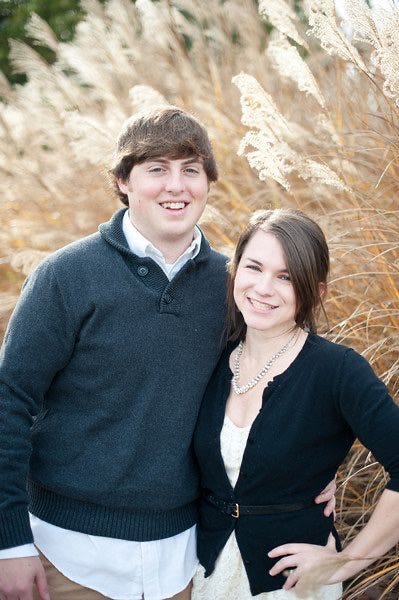
Yeah, yeah, laugh it up. You’re welcome.
(You can find a more recent photo if you keep scrolling.)
Around the start of the next year, I resolved to lose weight. The short story is that I ordered the P90X (s/o to Tony Horton) DVDs, completed both the exercise and diet program to a T, and lost a bunch of weight in the process.
Completing that program taught me a few invaluable lessons:
First, that I did have the self-discipline to complete a multi-month health and fitness program on my own. After you do it once, it gets easier the next time.
Second, that the nutrition aspect of health is at least as important—if not more important—than the exercise. Before that, I always thought being healthy was more about increasing my activity level. Turns out, diet is the 80% of the 80/20.
And lastly, getting healthy is one of the single greatest things one can do to influence one's well-being. If you had asked me whether I felt good prior to losing that weight, I probably would have said yes. But when I actually lost the weight, I realized how poorly I had previously felt. It’s like getting that first good night’s sleep after having a baby—you had no idea how tired you were until you finally felt rested.
There are all sorts of things I hadn’t learned, too... I was scared to eat carbs for years after losing weight. I lived as if working out wasn’t worthwhile unless it was super intense, and similarly, if my diet wasn’t “perfectly” calculated, I figured I might as well binge on whatever’s in the pantry.
Fortunately, over the past fifteen years, I’ve become (a little) more balanced and have come to realize that carbs aren’t evil, that a few days off my routine doesn’t mean I failed at life, and that rest is crucial. Cheers to #maturing!
15 Principles for Health and Fitness New Year’s Resolutions
What I’ve outlined below are a few of the things I wish I had known when I was just getting started. Some of these are tactical; others are philosophical. Both matter.
The real game is formation: learning to become the kind of person who makes the healthy choice more often than not.
If like me, you’re staring down a year of health and fitness goals, I hope this helps…
1. Dieting is simple; don’t overcomplicate it.
If you want to lose weight, you need to be in a caloric deficit. If you want to gain weight, you need to be in a caloric surplus.
It’s pretty much that simple.
It took me wayyyyy longer than it should have to cut (unhealthy) weight my first go around because I overcomplicated things. I obsessed over what was “optimal” (as if it needed to be) instead of just getting started with something sustainable.
Do something that feels sustainable and iterate along the way. Choose a lifting program, walk at least 10,000 steps a day, and eat fewer calories than you expend.
It’s not easy, but it is simple. Hard ≠ complicated.
2. Track your calories.
Unless you’re an expert, you probably can’t track your calories on vibes. And honestly, I generally low-key judge anyone who tells me they’re trying to lose weight but not tracking their food intake. I’ve just never met anyone who has lost significant weight and kept it off for any meaningful amount of time without tracking what they eat.
Fortunately, there are many tools available to help with this. My favorite is Macrofactor (not an affiliate code), and it’s probably my favorite app across any industry. Another popular one that many of my friends have had success with is MyFitnessPal.
Macrofactor is way better (see, this is what I meant when I said I was opinionated), but the point isn’t Macrofactor; the point is awareness around how much you’re eating.
3. Accountability is a cheat code.
I’ve met weight and fitness goals on my own in the past, but some of the best progress I’ve ever made was through a program called Dad Unit with a few friends. This particular program runs 3 months, and you complete it as a cohort (or “unit”… s/o Team Helo). Knowing that a bunch of guys were ready to call you out if you didn’t “check the boxes” that day was highly motivating.
Structure + Accountability = Results

It’s also 1) more fun to do things like this with friends, and 2) is an opportunity to make new (better, more fit) friends.
(As an aside, there’s also a Mom Unit.)
4. The best time to start is now. And the best time to work out is in the morning.
It doesn’t matter what you have coming up—just get started. There’s always some upcoming holiday or event or trip that will make things challenging. I almost didn’t sign up for Dad Unit because it ran from mid-October to early January, which meant I’d be cutting through the holiday gauntlet of Halloween, Thanksgiving, Christmas, and New Year’s Eve.
But Shawn (Dad Unit) helped me reframe it as 4 days of overeating (plus my anniversary) versus 4 months of overeating. Despite eating my chubby little heart out for those four days over the holiday season, I still dropped 15lbs throughout the program. Consistency > perfection.
The best time to work out is in the morning. Full stop. It’s a hill I’ll die on. Mornings are less likely to get hijacked by the demands of work and family. It just requires the willpower to get up.
Yeah, yeah, yeah, there are always exceptions. The principle here is to find a time that you can count on… but most of the I don’t have time is really I don’t want to get up earlier—and that’s different than not having time.
5. Organize every meal around protein.
A simple hack for eating healthier is to prioritize protein at each meal. If you can fit 30-40 grams of protein in at a meal, you’re going to feel fuller and be less likely to eat crap. Annndddd, if you’re one of those people who insist on vibe-eating, this is a great rule to follow.
Here are my favorite proteins for each meal:
Dinner: Seafood (salmon and shrimp, in particular), chicken, ground chicken, leaner steak, and pork cuts.
Lunch: Canned tuna or salmon (creating a good tuna-salad recipe was a game-changer), Greek Yogurt (I love Oikos Triple Zero during a cut), or leftover protein from the previous night’s dinner.
Breakfast: Eggs (egg whites if you’re on a cut), protein shake, Greek Yogurt.
Snacks: Barebells Bars, David Bars, canned sardines, or canned calamari.
This is a great rule for eating out, too. If you have to eat out and are on a cut, find a steak or seafood entree and order vegetables as a side. It will likely still have more calories than if you cooked it at home, but it won’t set you back nearly as much.
The key here is to find your favorite proteins and stick with them, which leads me to…
6. Eating the same thing every day is a health superpower.
This might be the most practical tip in the whole post: Having 2 to 3 “default” meals you can repeat will make life easier. It reduces the intense cognitive load of deciding what to eat each day, which is often the hardest part of cutting weight.
I have two go-to breakfasts, lunches, and snacks.
For breakfast, I almost always have eggs or a protein shake. If I’m on a cut, I’ll do mostly egg whites rather than whole eggs (since egg yolks have a lot of fat).
(Often I’ll have eggs first thing in the morning and a shake mid-morning since I usually eat four meals a day, even during a cut. If you don’t work from home, check out Fairlife Protein Shakes or Vital Proteins Protein Shakes—you can find both at Costco—they’re delicious and a big-time macro cheat code for cutting weight.)
For lunch, it’s yogurt (Oikos Triple Zero + 2.5 ounces of Catalina Crunch + 2 ounces of wild blueberries is about 375 calories with 40 grams of protein AND delicious) or canned tuna/salmon salad. Taking 10-minutes to find a good tuna or salmon salad recipe is worth it. Here’s mine (and a few others).
For snacks, I’ll stick to mostly fruit. I like to buy fresh blueberries, freeze and bag them, then scoop a small cupful whenever I’m craving sugar. Otherwise, I usually have a few apples each day. For dessert, I’ll have a Barebell Protein Bar. They’re delicious. If you are dairy-free and/or gluten-free, Krista loves Misfit Protein Bars.
A warning about snacks: I try to prioritize fruit because the snacks marketed as “healthy” are typically only healthy in small portions. Sure, you can “overeat” frozen blueberries, but have you ever met someone who got fat eating too many blueberries? Neither have I. The damage you can do eating a gallon bag of blueberries is not as significant as eating four sleeves of “healthy” Oreo knock-offs.

(Click the link above to watch a bit from Nate Bargatze about people warning him to be careful about eating too much fruit.)
Dinners are more difficult since many of us are also feeding a family, and they don’t necessarily care about your diet. Krista and I plan our dinners on Sundays, which ensures we’re on the same page. It’s always protein (Shrimp, chicken, etc.) plus a vegetable (brussels sprouts are a favorite), and maybe something starchy like a potato. We’re not big pasta people, so that’s not an obstacle for us. If Krista and the kids opt for pizza, I at least know which night it’s happening and can make my own plans (or we make this delicious pizza with a crust made from ground chicken).
A note about cost: People are quick to point out that eating whole foods is “expensive.” In my experience, it’s less expensive (or a wash at worst) because I’m buying fewer snacks and eating out less.
7. If you’re serious about cutting weight, cut out alcohol.
Alcohol is one of the easiest ways to derail a cut. If you’re cutting weight, cut out alcohol until you’ve reached your goal weight—no exceptions. I’m not saying forever (yet); just until you’ve reached your goal weight. Anyone I’ve ever talked to who has gone from a few casual drinks a week to no drinks for at least a month raves about the benefits (not only in terms of health, but also things like improved connection with their spouse and family, etc.).
If I became Theocratic-King-of-the-Whole-Entire-World™, I’d ban alcohol because I think it has zero health benefits and generally does more harm than good.
(In case you’re worried, it’s important to Krista that you know it’s highly unlikely I become Theocratic-King-of-the-Whole-Entire-World™, and that she’ll continue to enjoy a glass of wine in the evenings).
All that said, I recognize my position would put me at odds with many of my heroes like G.K. Chesterton, C.S. Lewis, or J.R.R. Tolkien.
8. The 4-week rule: Everything gets easier after week 4.
If you stick with a program consistently for 4-weeks, it will get easier. You might even start enjoying it.
This has largely been my experience, especially with running programs. When I start, it’s hard, and I hate it. Then, somewhere around the 4-week mark, I start to… enjoy it. The dopamine high from running is a real thing.
Whenever I start a cut, it feels like NOTHING is happening for at least the first two weeks. Yes, the scale usually drops quickly in the very beginning, but then it gets harder. It’s also hard to see progress on a day-to-day basis… until like 4-weeks.
Compare your picture on day 1 to day 28. You’ll see a change. It’s motivating. And it’s usually enough to get you through your second 4-weeks. Once you’re 8 weeks in, it’s a habit.
Anyone can stick with something for 4-weeks, right?
Progress can be made quickly. It doesn’t always feel that way because it’s harder to make progress than lose progress—but it takes less effort than people think to start feeling (and looking) better.
Warning: You will get sick in the first 4-weeks. Or your kids will get sick. Or something will happen that will (attempt to) derail your progress. Stay focused on the long game: A few days recovering from an illness is nothing in the grand scheme of things. Take the time you need and then pick up where you left off.
9. Sleep is the first thing you do, not the last thing you do.
This is my single-greatest piece of advice: Treat your day as if it starts at sundown.
Hang with me.
Most of us believe that our day ends with sleep, but it actually starts with sleep. It is, quite literally, the first thing we do each day. And nothing will impact your day-to-day in a bigger way than your sleep.
So, set yourself up for success by committing to 7 hours of sleep each night.
But another thing I do to “kick off my day” is quickly outline in my journal what my next day will look like each evening. My day is already laid out in my digital calendar, but writing it down the night before gets me to intentionally decide things like where I will fit my workout in the next day, when I’ll do all those little to-dos (e.g. run an errand) that might not be on the calendar, and brain dump anything on my mind that I did not get to that day. Not only does it help me prepare for the next day, but it also helps me sleep (and there’s scientific evidence that shows brain dumping unfinished tasks onto paper at the end of the day improves sleep).
It’s a small, but powerful mental shift to view the evening as the start of the next day.1
10. Your family will either be an obstacle or a cheat code (and it’s your choice).
Let me preface this by saying: I’m a slow learner. When I started my health and fitness journey, I believed that my family was obligated to do everything in their power to support me. I took resistance as an act of war on my health.
You all are wiser than I, so I’m sure you’ll avoid going that route.
The best-case scenario is 1) recognizing that you and your spouse may have different health goals, and 2) having a conversation with your spouse to get on the same page.
And guess what, “getting on the same page” doesn’t mean getting your family to cater to your health goals. It means identifying the points of tension and finding ways to transform them (or at least limit their inconvenience to the family).
One of my big, more recent wins was learning to love cooking again…
Tension: Having to eat something different from what my family eats, thus having to make two different dinners and try coordinating them so we can eat as a family.
Transformation: Me, making something delicious for dinner that the family enjoys and helps me reach my health goals.
And, of course, the icing on this proverbial low-sugar, protein-packed cake is that the family is eating a bit healthier, too.
Many of the tensions can become blessings if you realize your agency.
The point is this: Your health endeavors can cause strife within your family or be a huge blessing, and the choice is yours.2
11. Planning is the difference between long-term success and failure.
The “just vibes” folks won’t love this one, but the more responsibilities you carry, the more planning you’ll likely need to do to be successful.
This doesn’t mean intense meal planning. You know, the sort that requires your meals to be pre-made each week. It can look like this…
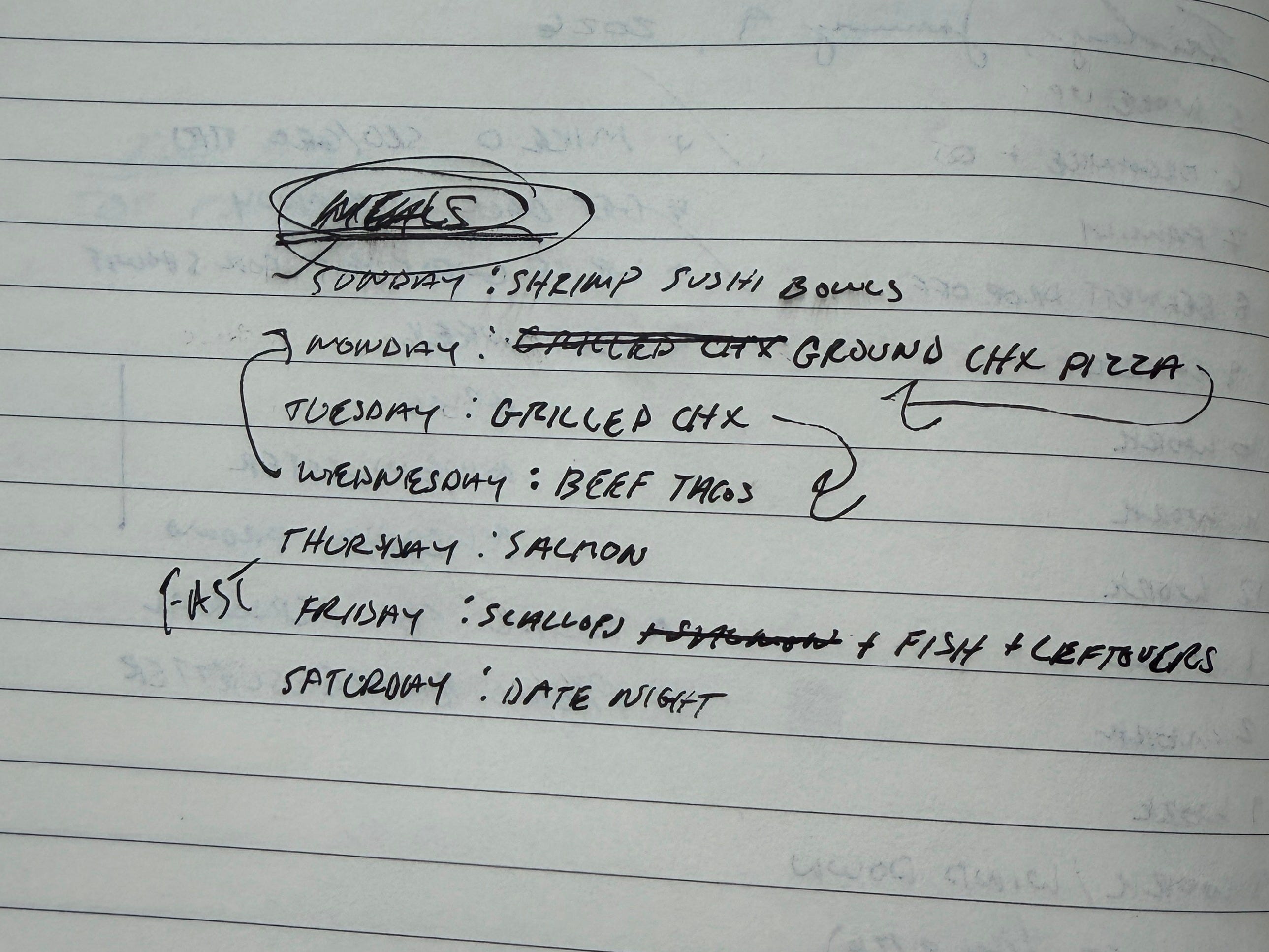
That’s the result of a quick conversation between Krista and me about what we’re having this week. That’s enough planning for us because we work from home and have a bit more flexibility in our day.
There are lots of ways to do this, but here’s what planning looks like for us:
Quick Sunday conversation with Krista about what we’re eating for dinner that week. We take into account what we have going on each evening, like sports practices, so that we plan something appropriate.
I have an evening journaling practice that takes me 5 minutes and allows me to 1) brain dump any “to-dos” still on my mind that day and 2) organize the next day (see above).
And that pretty much helps me head off 95% of issues that would prevent me from getting in a workout or clean eating.
Planning also means having a plan for your workout. I once heard someone say, “Training and exercise are two very different things.” (I wish I could remember who), and it really stuck with me.
His point was that training includes intention, whereas exercising doesn’t. Regardless of how you feel about that, what I have found helpful is a small mental shift: Making sure I always have a goal for my training so that I know I am actually pushing myself versus merely showing up.
12. Cardio is not the best way to lose weight and keep it off.
Listen, I don’t think cardio is bad. In fact, though I now prefer weightlifting over running, I preferred running over lifting for most of the last fifteen years. I’m also not suggesting that you can’t lose weight doing cardio. I’m simply suggesting that it’s not the best way to lose weight and keep it off.
All that said, two realizations I’ve had—one very recently—are that my weight fluctuates much less when I am lifting (and thus building muscle) and when I'm committed to 10,000 steps each day.
I’ve found that a step goal keeps me active even when I don’t have a cardio-centric health goal like training for a race, and it keeps me active on days where I don’t have a run planned. I imagine steps are also a more appealing benchmark for many people with injuries or who are injury-prone who want to avoid running.
Committing to at least 8-10k steps is very sustainable. It requires intentionality, for sure, but it’s very doable on a daily basis. If you work an office job and you’re not intentional about how much you move throughout the day, you probably move a lot less than you think.
13. Learn to cook.
Learning to cook delicious, nutritious meals for the family has never been easier thanks to social media, countless blogs, and ChatGPT. I’ve learned to really enjoy making meals I find on social media or blogs, and then adjusting them based on my health goals using an AI tool.
In just the past week, we’ve made versions of bang-bang shrimp, homemade chicken nuggets, pizza with a ground-chicken crust, and other recipes the whole family enjoys.
Krista previously did nearly all the cooking in the house, so another blessing of this newfound love for cooking is that it’s become something we can do together. Other benefits include making food that actually tastes good while cutting weight and eating out less because you enjoy what you eat at home more.
14. Recognize the mental and emotional aspect of it all.
The mental and emotional component cannot be understated. It’s a vicious cycle, really:
Healthy decisions → feeling better → making more healthy decisions
Unhealthy decisions → feeling poorly → making more unhealthy decisions
So, how do you avoid the unhealthy decision cycle? I think there are two important steps one can take:
First: Planning helps you avoid situations that make it difficult to make a healthy choice. Enough has been said on this point.
Second: Recognize your mental state, especially when you’re hungry, angry, lonely, or tired (in therapy, the acronym is HALT—ask me how I know). For me, I’ve found that if I binge on junk food, there’s a 99% chance it was because I was tired.
Otherwise, find mental tricks to make it easier to choose the healthy decision.
One of my friends who is a runner (I’m not a runner; I’m just a guy who likes to run—there is a difference) once told me that when he doesn’t feel like running, he just tells himself he’s going to put on his running shoes. If he doesn’t feel like running after he gets ready to run, he won’t do it. 99% of the time, he goes for the run.
When I’m craving sugar and want to eat junk food, I’ll have a cup of frozen blueberries (even if I don’t have the calories left for it). I tell myself that if I’m still hungry after the cup of blueberries, I’ll have the snack. 99% of the time, I don’t.
15. Give yourself grace and move on.
You’ll get sick, you’ll overeat, you’ll go on vacation and enjoy foods you don’t normally eat—that’s life. If you treat health as a lifelong endeavor, a few sick days or a week of gluttony at the beach won’t matter in the grand scheme of things. It can be hard to remember that in the first few weeks of your journey, though.
This, you might have guessed, has been the hardest lesson for me to learn.
If this feels like a lot, know that I didn’t make all these changes overnight. Consistently making healthy choices led to healthy habits… and after a while, it becomes less of something you choose and more of something you do.
Choose Your Hard
I often find cliches unhelpful, but the “choose your hard” mantra motivated me as I tried to become healthier.
It’s hard to make healthy choices—especially in a society that makes bad choices so convenient (and often marketed as “healthy”). But it’s also hard to be unhealthy and deal with consequences such as fatigue and brain fog, at best, and chronic disease or worse, at worst.
It’s also important to recognize that many aspects of health are beyond our control.
My mom, who had a relatively healthy lifestyle, passed away from Leukemia in her 40s, and I have other family members who have various autoimmune challenges that are likely genetic. Those experiences, especially the early death of my mom, have motivated me to take my health seriously (although admittedly, it has also sometimes led to an unhealthy obsession or “idolization” of my health—a topic for another post, I suppose). More than that, though, I think it’s been a reminder that it’s such a gift to have any influence over our health at all!
Anyway, if you’re setting health and fitness goals this year, I hope you’ve found at least one of these tips helpful. Godspeed!
I wish I could take credit for this, but many ancient cultures viewed sundown as the beginning of the next day (hence why some cultures will fast from sundown to sundown).
I think this is especially true for men. Note that I did not say it’s only true for men.